Showing posts with label Period Drama. Show all posts

Sunday, June 26, 2016

My Thoughts on Sherlock Holmes

I've wanted to watch this for a few years, and since it's one of the few movies I haven't read a review for on Plugged In (a review website by Focus On the Family), I didn't know really what to expect. Outside of a relatively "normal" mystery in Victorian London.

To tell the truth, I was unsure about how much I'd like a Robert Downey Jr. Sherlock - but I was quickly proven wrong. There were several times that I couldn't help but laugh out loud. I think my absolute favourite part of the whole movie was when Sherlock jumped out of a window with an electrically-charged fork-thing in hand and ended up face-planting on the cobble-stone street below.

Now, when I said I was expecting a "normal" mystery, I meant something along the lines of: someone's murdered and they end up chasing the murderer all around the city.

Someone was murdered, several people in fact. But this is where it gets really weird.

More often than not, I forget how weird the Victorian era. The Victorian era was filled with strange beliefs and odd rebels who wished to push the boundaries of science. And that was the backbone of this Sherlock Holmes story.

The movie opens with Sherlock making his way down into a stone room under a large, multi-floored building, taking out bad guys as he goes. Soon, he comes upon a balcony looking over the room and peers down at a strange ritual taking place. Low, evil-sounding chanting fills the air as a young woman writhes on a stone table. The chanting's coming from the man in a long, ornate robe, a hood obscuring his face. As the chanting continues the young woman slowly lifts a knife, poised to thrust it into her own chest.

But before she can do that, Sherlock is there, taking out bad guys.

The chanting, robed bad guy is arrested and locked away - and it turns out that the scum-bag is a lord, Lord Blackwood in fact. And he's known in London's most prominent cult as the most evil individual to them, that he wields dark magic.

I wasn't exactly comfortable with how much of the cult was in the story, because it was borderline Satanist and there were pentagrams and rituals, etc. But I enjoyed the characters - I think Watson was my favourite. I love the Victorian era, even if London in that period was really depressing.

I really hope that the sequel is a little more normal, even if that normal is Sherlock and Watson chasing after Moriarty at night. I just don't like to watch movies that make me squirm in my seat. Though I did laugh...

Friday, June 3, 2016

My Thoughts on The Lion, the Witch, and the Wardrobe (2005)

When I was little, it had to be when I was in either Grade 2 or 3, I came home to find that my father had gotten me the complete The Chronicles of Narnia box set. As frequently as he was able, he would sit me on his lap and read to me. I believe he managed to get to The Horse and His Boy before he stopped reading to me because my brother wouldn't sit still and life got in the way.

This film version of the movie is my favourite. Based on the second book of the series, I think it does very well with the story-line, though it has been a while since I've stopped to read it. Either way, I enjoy this movie, and wished that I had sat down to watch it again sooner. I used to watch it over and over when I was younger, but it seems I've not touched this one for quite a few years.

One thing that occurred to me while I was watching this was how the people of Narnia had no idea what a human was at first glance, but they seemed to remember that humans existed before. And humans did exist in Narnia prior to The Lion, the Witch, and the Wardrobe - they were brought there by Aslan himself at the dawn of Narnia's creation. But they all seem to have left and/or died out, and the only known human population exists down in Calormen.

Calormen, to the south of Narnia, separated from Narnia by Archenland.
Honestly, it does bring up the question of why Aslan didn't just bring two brothers and two sisters up from Calormen, because they are sons of Adam and daughters of Eve, even if they don't live on Earth. But since I've been a Narnia fan for as I can remember, I know that Aslan probably brought Peter, Susan, Edmund, and Lucy from Earth and to Narnia so he could bring both worlds together.

C.S. Lewis was very meticulous with the contents and themes of his stories.

What I love most about The Lion, the Witch, and the Wardrobe is the fact that it's an allegory to Christ's crucifiction. In both the book and the film of The Voyage of the Dawn Treader, before Aslan opens up a portal to Earth through the stationary tsunami (or sky, as it was described in the book), this conversation happens:

/\

' "You are too old, children," said Aslan, "and you must begin to come close to your own world now."

"It isn't Narnia, you know," sobbed Lucy. "It's you. We shan't meet you there. And how can we live, never meeting you?"

"But you shall meet me, dear one," said Aslan.

"Are - are you there too, Sir?" said Edmund.

"I am," said Aslan. "But there I have another name. "You must learn to know me by that name. This was the very reason why you were brought to Narnia, that by knowing me here for a little, you may know me better there." '

\/

In this conversation that I decided to borrow from the fifth book of the Narnia series, it hints at the fact that Aslan is actually Jesus, and that he decided to take on the form of a lion in order to guide four children. When I say that The Lion, the Witch, and the Wardrobe is an allegory to the crucifiction is because Aslan died on the stone table (which represents the cross), taking Edmund's place like Christ took on our sins so we could be forgiven ^u^

I love ever aspect of this movie, despite the fact that it shortened the story-line a bit because it was obvious that they didn't want to make the movie as long as, say, The Lord of the Rings. And if they added all the details in the movie probably wouldn't have been suitable for kids and the rating might have not been a mere "PG" - and might have inched closer to "PG-13". Or dare I say. "R" like the third extended Hobbit movie (though it probably wouldn't have made it that far since they probably still kept the gore low key)?

I chose to review this as a Period Drama because the Pevensie children originate from World War II London. Peter, Susan, Edmund, and Lucy were evacuated from their home in London (I always assumed it was London since it was being bombed, though I could be wrong). The Lion, the Witch, and the Wardrobe exists as a high fantasy that exists in both the WWII era and the medieval era.

As a parting note I would like to say: even after all these years, I still like how the phoenix was summoned during the battle. And I can't wait to watch and review Prince Caspian!


Thursday, June 2, 2016

Period Drama Challenge April & May Tag Questions

1. What period dramas did you view in April & May?
I viewed The Princess Bride and Belle in April. Unfortunately, I didn't view anything in May. I was busy in May with trying to get a job and reading From This Moment and working on my poem collection project "Blue Jays & Rainy Days". I aim to fix that this month, before I'm caught up with moving to our new home :3 I also attempted to watch "To the Ends of the Earth" last month but couldn't even stomach the first episode. :P

2. Do you prefer to watch period dramas that have a happy ending or a bittersweet ending?
I prefer happy endings over bittersweet ones. I remember watching a Civil War era film some years ago about a Yankee soldier and a foal, and in the end the soldier died during a battle shortly after he and a soldier from the south worked to pull the foal out of the river in the middle of the battlefield. The Yankee soldier was the main character! He wasn't supposed to die!

3. What media forms do you prefer to use when watching period dramas (i.e. purchased DVDs, rented/borrowed DVDs, Netflix, Amazon Prime, Hulu)?
I prefer to watch DVDs I've purchased and I use Netflix liberally, since ordering anything from the library takes too long and my town doesn't have a rental store anymore. I also don't have CraveTV, and Hulu's not available in Canada yet.

4. Which period drama character's wardrobe would you like to own?
I would have to say that I would love to either have Dr. Julia Ogden's (Murdoch Mysteries) wardrobe or Olivia King's (Road to Avonlea) wardrobe. They're both so spectacular! Even though I'd rather not have to wear a skirt.

5. What period dramas are you looking forward to viewing in June 2016?
I hope that I can watch either a few episodes or an entire season of Murdoch Mysteries. Thankfully, each season isn't very long, but if I want to have a life outside my computer, I might only be able to view a few episodes :/ I might also watch one of the Chronicles of Narnia movies, if I'm able to find them. I think either The Lion, the Witch, and the Wardrobe or Prince Caspian may be in my family's massive black movie case...

I might also watch Tuck Everlasting, since I've been wanting to watch it again, but I have to borrow it from the library.

Thursday, April 21, 2016

My Thoughts on Belle


The year is 1769.
Britain is a colonial empire and a slave trading capital.

When I saw Belle on Netflix, I thought it looked like a rather interesting story. I don't see very many Period Dramas about those who do not have light skin.

Belle is about Dido Elizabeth Belle Lindsey, the biracial illegitimate daughter of a British naval officer and an African slave. Her father lost track of her until he found her again in the slums and took her home. She only really knew him for a few hours before he had to go back to sea, and he died out there before ever coming back.

Belle is full of themes about racial inequality, about how the colour of your skin, way back then, placed you in a class of respect no matter what your social class was. If you were white, you were fine. But if you were black, or even half-black, you were dirt. Because blacks were slaves.

But Dido wasn't a slave. Her father had money, he was wealthy, and she inherited it all when he passed away.

In the beginning, the Murrays and her new aunt were a little shocked and didn't know how to really go about this since Dido was the bi-product of an extremely sinful act and she wasn't white. But what I loved was that they grew to love her in a way that she was a member of the family.

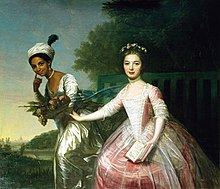
I loved how accurate the film was to the time period and the fact that Dido eventually found the love of her life. I also loved how Dido was a real person, even though she's been hidden by time. Thankfully, she sat still enough to have her picture painted, so we know what she looks like to an extent.

I found it very interesting how Belle took place around the time of the Zong massacre - where a British captain and crew threw the entire quantity of slaves off the ship and let them drown because the drinking water was running low and the slaves were "diseased". The slaves were diseased because they were packed too closely together, and the ship passed by eight ports where they could have gotten water. According to history, the captain and crew did this in hopes of claiming insurance money on the slaves, which would amount to more than what they would have gotten for sick slaves. But thankfully, it was ruled that the insurance companies pay nothing to the Zong crew and it was thought to be one of the events that eventually lead to the outlawing of slavery all-together.

I'm also glad Dido didn't choose to marry the rich guy. His family was really only seeking after her money, anyway.

It was a relatively satisfying movie, and it helped remind me what society had to go through to get to where we are today.

The conversation that stuck with me...

William Murray (Dido's great-uncle): "This is not about Miss Lindsey."
John Davinier: "Of course it is! It's about all of us! ...It's about everything. ...Everything that's important!"
William Murray: "Mr. Davinier, ... the world is a devastating place. You must protect your emotions if you wish to prevent matters of law and...love from devastating you."

Tuesday, April 19, 2016

My Thoughts on The Princess Bride

It's been a while since I've watched this movie, and suffice to say, I really wasn't in the mood to watch a romantic-comedy. I was more in the mood for just a romance. But oh well.

The main characters of this film are Buttercup and Wesley (the farm boy). How Wesley met Buttercup is simple: he met her when he signed up to be her farm hand (not shown in the film, obviously happened before the beginning of the film). Buttercup loved nothing more to order him around when she wasn't riding her horse around her property or doing whatever she did with her farm that she could do without Wesley's help.

The film is rather quite vague about the early events of their relationship, but what I do like is that it does make it clear that their attraction with one another wasn't instantaneous. Wesley was the first one to fall in love, and I guess that it was apparent enough that Buttercup knew, but I feel that she didn't immediately reciprocate. In fact, as it shows, Buttercup doesn't realized she's fallen for Wesley until Wesley leaves to go and "seek his fortune", since he had nothing for Buttercup. He wanted to marry her, but he needed the money.

Unfortunately, during his boat-ride to wherever he was going to find work, the ship he was on was attacked by the Dread Pirate Roberts, and he was seemingly lost at sea. Buttercup learned of this, and fell into a great depression.

Now, I know this doesn't sound like much of a comedy - yet - but this is because this movie, and the book it was adapted from, were very well done. In various writing curriculum I've gone through, The Princess Bride has been mentioned at least once due to its beautifully-done plot. If this movie started out as a comedy right from the get-go, I believe it wouldn't be as much of a cult-classic as it is regarded as today.

What I like most about this film is the fact that it is different from the average movie-adaption. Instead of dumping us right into the world of the story, it starts out in the "real world". There's a young boy (not named), and he's down with a bad cold or the flu. There's only so many comics or 8-bit video games one can play before they become utterly and all-consumingly bored. His grandfather comes over with an early-Christmas present in hand, knowing exactly how to break his grandson's boredom, even though the boy might not be so willing to sit and listen to what he might think is a "sappy love-story".

I loved how Wesley looked as the Dread Pirate Roberts/The Man in Black (I have something for men with British accents wearing bandit masks, apparently).

The only thing I didn't like about the movie is that the grandson used Jesus' name in vain (like, was that exactly necessary?!), and the fact that Inigo used the b-word while fighting the six-fingered count at the end of the film.

And why, oh why, did I keep hearing the word "indigo" instead of "Inigo"?? Their accents kept making me insert a "D" into the name!

Despite all that, these are my two most favourite quotes:

Shortly after Wesley saved Buttercup after she was kidnapped:

"Life is pain, Highness. Anyone who says otherwise is selling something."

And when Inigo was fighting the six-fingered count:
"My name is Inigo Montoya, you killed my father, prepare to die!"

Thursday, April 14, 2016

Period Drama Challenge

Old-Fashioned Charm
Hosted by Miss Laurie of Old-FashionedCharm (sign up)
The Period Dramas I Will Watch:
I'll start with 5 - I may watch more. But I'm in a bunch of other challenges, and since I am trying to write a complete novel, and I am trying to up the amount of novels I want read...well...I'll have to see :3

Ranger's Apprentice: The Battle for Skandia, a review

The Battle for Skandia . John Flanagan. 2006. Puffin Books. Pages: 294. Price: USD $8.99/$11.99 CAN. Setting: Skandia. ISBN 0142413402. [S...