Showing posts with label Book Reviews: Fantasy. Show all posts

Saturday, June 8, 2019

Ranger's Apprentice: The Battle for Skandia, a review

The Battle for Skandia. John Flanagan. 2006. Puffin Books. Pages: 294. Price: USD $8.99/$11.99 CAN. Setting: Skandia. ISBN 0142413402. [Source: Bought]

• • •

Far from home after escaping slavery in Skandia, Will and Evanlyn's plans to return are spoiled when Evanlyn is taken captive. Will employs his Ranger training to locate his friend, but soon finds himself fatally outnumbered—until Halt and Horace make a daring, last-minute rescue. But their reunion is cut short by the discovery that Skandia's borders have been breached by the Temujai army—and Araluen is next in their sights. Only an unlikely union can save the two kingdoms, but can it hold long enough to vanquish a ruthless new enemy?

• • •

Rating: 5/5

Ah, the days when I was 16 and hormones were raging, and I was utterly clueless...

The Battle for Skandia is the fourth installment of John Flanagan's Ranger's Apprentice series, and I think it's by far the most entertaining (which is strange because this was the one that took me the longest to read, but that's probably because I was a bit distracted). It is also the satisfying conclusion of the story presented in the previous novel (The Icebound Land), where we were left wondering if Will would ever come out of the drug-induced fugue-state he was in—until he did, right before the words ran out and the book ended!

A lot has happened to Will since he became a Ranger's Apprentice. He's trained under his mentor, Halt—the Ranger of the Barony of Redmont—gone to war against the warlord Morgarath and the Skandians, been kidnapped by a band of Skandians before the war with Morgarath was even over, been a slave for a while and drugged to the point that he couldn't be automatically taken off the narcotic without risking dying in agony...

When The Battle of Skandia opens, Will has just snapped out of the drugged-induced haze brought on the warmweed that had been forced upon him. He's not as in shape as he had been before he and his friend Evanlyn were captured. During her attempts to hunt meat, Evanlyn caught sight of a stranger in the frosty woods that stuck out like a sore thumb—because these woods belonged to Skandia and the stranger doesn't look one whit like a Skandian.

And by the time Will "wakes up" in the little cabin up on the mountain where he and Evanlyn have been hiding out from the Skandians, that stranger has become a real problem—he's a member of a scouting party from the Temujai Steppes in the East, and they've come to conquer Skandia for their boats.

One of the things I like most is that the world of Ranger's Apprentice is based on our own, with dynamics based on what was going on in the past. Araluen is obviously based on Britain; Skandia is based on Scandinavia; Celtica is based on Celtic countries, probably Wales or Ireland, since The Sorcerer of the North and The Siege of Macindaw reveal that Picta is based on Scotland, because historically Scots were referred to as "Picts"; and the Temujai Steppes are based on the Mongolian Steppes.

The way the world is built makes it feel different, but somewhat similar to what we know, grounding it in reality and not lifting it too far away for us to relate to it.

I thoroughly enjoyed this installment. The humour was well-paced and clean, never failing to make me laugh. But there were some things that made me stop and consider how old my (future) kids would need to be before they were scarred by those things. It's funny how you're forced to think like that when you're reviewing... haha...

Anyway, there are the obvious: Araluens take God's name in vain periodically, but not all the time, and the word "d**n" is used once in a while. The Temujai General has a concubine, and there are other things that I can't remember, on top of the general violence and unmentioned blood.

Every person and parent is different of course, so it's up to you if you wish to talk to your child about it. These "issues" are extremely mild compared to what I've seen, read, and heard, but I'm also 23 years old.

In my opinion, this book should be read 14 year olds and older if you or your child have been sheltered, even though the back cover says "10 years and up". But that's just my opinion.

Thursday, September 6, 2018

An Ember in the Ashes: a book review

An Ember in the Ashes. Sabaa Tahir. 2015. Razorbill. Pages: 480. [Source: Bought]

• • •

Laia is a slave. Elias is a soldier. Neither is free.

Under the Martial Empire, defiance is met with death. Those who do not vow their blood and bodies to the Emperor risk the execution of their loved ones and the destruction of all they hold dear.

It is in this brutal world, inspired by ancient Rome, that Laia lives with her grandparents and older brother. The family ekes out an existence in the Empire's impoverished backstreets. They do not challenge the Empire. They've seen what happens to those who do.

But when Laia's brother is arrested for treason, Laia is forced to make a decision. In exchange for help from rebels who promise to rescue her brother, she will risk her life to spy for them from within the Empire's greatest military academy.

There, Laia meets Elias, the school's finest soldier—and secretly, its most unwilling. Elias wants only to be free of the tyranny he's been trained to enforce. He and Laia will soon realize that their destinies are intertwined—and that their choices will change the fate of the Empire itself.

• • •

Rating: 5/5

I never knew that this book would become one of my absolute favourites, especially when I began to read it and found that it had been written in First Person Present. There aren't many novels written in First Person Present, and I often find it an annoying way to write because it presents the fact that, in logistics, when it's written that way, it kind of suggests that the book is being written as the events happen. And how can the main character be writing this when he's the middle of a battle or while she's being beaten by her master?

But this writing style didn't bother me while I read An Ember in the Ashes. Somehow, it actually helped.

The way Sabaa Tahir wrote her story drew me in and never let go. I couldn't put the book down! I actually felt regret every time I had to because I just had to know what happened next!

The characters were excellent. I felt I got to know Laia and Elias quite well. I grew to like them very much, and it got to the point that I was like "If you touch my son or daughter so help me—!" when it came to when Laia and Elias were punished for something. I'm not usually like that, lol.

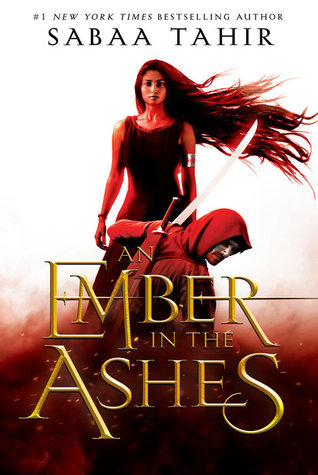
I love the cover—I know it's not the original, which is just as stunning—but it was one of the things that drew me to the story to the point I ended up getting it and buying it. I've been aware of it for a few years, thanks to bookstagram and other book communities that I'm a part of, but I never really bothered to check it out until now. It kind of reminds me of something my photography teacher told me when I was in college: "People love faces", meaning people respond to images with faces or face-like shapes in them. It seems to be true because I was ten times more attracted to the copy with Laia and Elias on the cover than the first one with their silhouettes and the stone texture on it.

The range of characters in this book was amazing. The brutality is realistic, and even frightening. I swear I found myself holding my breath half the time, but somehow I managed to breathe or I wouldn't be writing this post, XD And despite the fact that the world of the story was based on the Roman Empire, it didn't jump out of me until after I read the synopsis on Goodreads while I marked the book as read. 

The world itself is rich and doesn't seem like a copy. It always felt like I was there, almost as if I was standing next to, fighting next to, spying next to, the characters as the plot progressed.

I love books like that.

The theme and the story were very well done. I could tell that the overall theme was about freedom and that bravery comes in more than one form. It makes me kinda a little jealous, because I fumble with themes and it's always been a mist-like concept for me and when my English teacher tried to teach me about it and have me find it in a short story he had me read I kept drawing a blank, ha ha. But that doesn't mean that Sabaa made the theme too aparent—I say that I was able to see it clearly now that I think back to it because she wove it into her story masterfully. It makes my heart beat harder because not all authors are able to that!

Unfortunately, despite all the good things I have to gush about An Ember in the Ashes, there are still some downsides to it. There was some swearing, b-words but no f-bombs (thankfully). Rape is mentioned but never happens in the story. It almost happens to Laia a couple of times, but Elias was there to keep it from happening. Laia gets beat up by one of the Masks, but that wasn't the only instance of violence in the story. A lot of people die. Sabaa has a body count to rival Tolkien in this story.

But I would read this story again, definitely. It will stay on my bookshelf forever. I'm definitely getting its sequel, A Torch Against the Night, when I get my next paycheck (I'm trying to save money, lol), and when I'm finished that I'll get the one after that...

I love it when I find a book that I like ^^

Friday, August 31, 2018

The Golem and the Jinni: a book review

The Golem and the Jinni. Helene Wecker. 2013. Harper Perennial. Pages: 486. [Source: Bought]

• • •

Chava is a golem, a creature made of clay, brought to life by a strange man who dabbles in dark Kabbalistic magic. Ahmad is a jinni, a being of fire, born in the ancient Syrian Desert. Trapped in an old copper flask by a Bedouin wizard centuries ago, he is released accidentally by a tinsmith in a Lower Manhattan shop.

Struggling to make their way in 1899 New York, the Golem and the Jinni try to fit in with their immigrant neighbours while masking their true selves. Meeting by chance, they become unlikely friends whose tenuous attachment challenges their opposing natures, until the night a terrifying incident drives them back into their separate worlds. But a powerful menace will soon bring the Golem and the Jinni together again, threatening their existence and forcing them to make a fateful choice.

• • •


Rating: 4/5

I wish I could have rated this story as a 5 out of 5, but there were just a few things that knocked this story from favourite to merely a story I liked a lot.

I first learned of The Golem and the Jinni when I was looking through Goodreads for novels staring golems so I could find inspiration for a race of stone-like beings for one of my fantasy stories. The word "golem" had been bobbing around in my head for a while, so I looked it up. And when I saw it I thought I have to read this!

I'm so glad I did, because it opened my eyes to a time period in a part of the world I don't think about very often—or hardly at all.

The first thing I want to say about this book is that it was delightfully void of any swearing. I didn't have to worry about any unexpected s-words, b-words, or f-bombs. There was some blaspheming, but there's only so much you can expect from a secular author. It's very rare for a book such as this, though, to possess no swearing.

The second thing I want to say is that the authoress was delightfully sensitive in her handling of the three respective religions she included in the book: Judaism, Christianity/Catholicism, and Islam. The main two were Judaism and Catholicism, because the Golem was taken care of by a rabbi and the jinni was found by a Syrian Catholic. Only one character was Muslim—or he was—but in his flashback he was and she handled it well as well. Reading this book didn't make me feel as if she was mocking the faiths she decided to put in the book (which is awesome since I'm a Protestant Christian so I always have an eye for details such as this).

One of the things I didn't like was the mention of sexual intercourse. There were several points where it was mentioned even though the author wasn't overly explicit, only saying enough to let you know what the characters were doing. There were at least four different scenes.

The story was a tiny bit slow, but it was also delightfully engrossing. There were times where I couldn't bring myself to put the book down, and the cliffhangers were put in all the right places. The settings and scenes were all so real that I always felt like I was there, an invisible spectator standing behind the characters, watching everything unfold before me. There were parts to Ahmed's personality that I liked, some that I did not; and Chava had a personality similar to my own that had me connecting to her from the beginning.

I didn't see who was the villain until the last quarter, which didn't bother me even though the book had me following him from the beginning. It left me feeling quite surprised, which I don't experience with stories very often. There were parts that left me feeling sad for certain characters, and I think I even gasped once or twice while reading. I like it when a story latches onto my emotions and doesn't let go.

There looks to be a sequel to the story planned to be published next year. If it follows through I look forward to snatching it up so I can see what happens to Chava and Ahmed.

Until then I'll have to distract myself, lol.

Wednesday, July 18, 2018

The Sword of Shannara: a book review

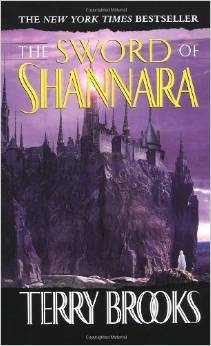
The Sword of Shannara. Terry Brooks. 1977. Del Rey Books. Pages: 726. [Source: Library]

§§§

Long ago, the wars of the ancient Evil ruined the world. In peaceful Shady Vale, half-elfin Shea Ohmsford knows little of such troubles. But the supposedly dead Warlock Lord is plotting to destroy everything in his wake. The sole weapon against this Power of Darkness is the Sword of Shannara, which can be used only by a true heir of Shannara. On Shea, last of the bloodline, rests the hope of all the races.

Thus begins the enthralling Shannara epic, a spellbinding tale of adventure, magic, and myth...

§§§

Rating: 3/5

When the librarian at my library suggested this book for the "library staff recommendation" category of the Bookopoly Reading Challenge my library is hosting, I was happy because my Dad had read it once so there was a bit of a legacy going on with how he read it and then I read it...

Maybe I'll make one or all of my kids read it when they're around my age, just so they can learn to appreciate well-written novels. I'm not saying that The Sword of Shannara was well-written, but it is something I've grown to expect from a majority of the novels from the era that in which was published.

So, while I wait for the forecasted thunderstorm to come barreling over my home, I'll discuss the pros and cons, and the things I liked and disliked about the story.

As the title of the novel suggests, The Sword of Shannara is about the Sword of Shannara—to an extent. It's mostly about Shea Ohmsford, and the fact that he's the only one left who can properly use the thing.

At the beginning of the novel, we're introduced to Flick Ohmsford—Shea's adoptive brother. He's walking along, on his way home from helping some of his fellow Man who live on the outside of the Shady Vale, the quiet and quaint Shire-like sanctuary protected by the Duln Forests that surround it on all sides. Suddenly, he comes across a stranger who seems to leap from the shadows of the trees to ask him for directions to a place to stay in nearby after nearly giving poor Flick a heart attack.

This is how Allanon, mysterious historian of the Four Lands, came to stay in the Inn of Curzad Ohmsford, the father of Flick and the man who took in Shea when his mother died. And that is how Allanon found Shea, and ultimately sent Shea and Flick on the adventure of their lives.

Now, this is the kind of story that leaves me feeling a bit disappointed when I finished it. Yes, I made it all the way through this 726-page MONSTROSITY (I say that because of its length, not because it was so bad as it could be considered monstrous), and I couldn't be more happy because now I can finally read something else.

But I didn't hate this book as much as some of my fellow Goodreads users. No, I think I was okay with it, but I feel it could have been stretched out a bit. The Sword of Shannara itself could have been stretched into its own trilogy in my opinion, with more details and more attention to each event as they happened. Then, The Elfstones of Shannara, and The Wishsong of Shannara could have continued on afterwards as consecutive instalments in a series.

There was too much crammed into this one book, in my opinion. Scenes were too generalized and I noticed that several important, probably pivotal conversations were glazed over and only described. Secondary characters were hardly introduced before they were thrown into battle where they were slaughtered (though I was kinda sad that Sheelon was killed by his fellow man because he had survived so long that it seemed he should have been allowed to die of old age and not in battle).

The main characters, too, kinda felt half-baked. Shea appeared and we weren't given much of a background other than he was the last living descendant of Jerl Shannara and he's the only hope for the whole world and his father was an elf and his mother was a human from Shady Vale and that when he was a kid Curzad adopted him. There was no mention of what he liked to do in the day, or much describing of what he did in his day to day life. What was his job? How did he help Curzad and Flick run the Inn? What were his dreams? hopes? passions?

Who Is Shea Ohmsford?

Who Is Flick Ohmsford?

Who Is Menion Leah?

Who Is Balinor Buckhannah?

Durin?

Dayel?

Hendel?

So many questions and no answers. That is one of the reasons why I'm disappointed about this book. I can only hope that The Elfstones of Shannara is better than The Sword of Shannara. I'm not holding out much hope though, and it will be a while before I pick up the next instalment of the trilogy.

I made the point of making a list of all the things that were similar between The Sword of Shannara and The Lord of the Rings because I wanted to know if the novel really was as bad as a lot of people on Goodreads proclaimed. Everyone's entitled to an opinion, but I like to stray from the pack that tends to follow and agree with those who rant and rave about how bad something is.

Similarities:
  • A wizened old man (Gandalf / Allanon) comes to the main character warning them of coming danger.
  • Two characters (Frodo and Sam / Shea and Flick) flee their home from ghostly bad guys out to get the main character.
  • They encounter an ally in the first town they come across (Strider in Bree / Menion Leah in Leah).
  • Unearthly monsters chase them through the wilderness.
  • They battle a tentacle monster in a swamp (at the door to the Mines of Moria / in the Mist Marsh).
  • There was an epic battle between wizard-figure and servant of the evil overlord over endless pit (Gandalf versus Balrog / Allanon verses Skull Bearer).
  • The evil overlord's land is shrouded with shadow (Moria / Skull Kingdom).
  • An evil advisor has control over the ruler of a strategic kingdom (Grima Wormtongue and King Theoden / Stenmin and Prince Palance Buckhannah).
  • The evil overlord's forces attack the last real defence of the lands of the Free People (Minas Tirith / Tyrsis).
  • The evil overlord is defeated by a magical object.
I also made it a point to jot down any differences that I noticed, because there is enough of a difference that The Sword of Shannara is just able to stand on it's own. Just.

Differences:
  • While Gandalf returns 17 years after Bilbo's Birthday Party and sends Frodo and Sam off on their adventure, Allanon warns Shea the day after he arrives at the Ohmsford's Inn.
  • The two-character dynamic in The Lord of the Rings is friend with friend fleeing the Shire, while the two-character dynamic in The Sword of Shannara is brother–brother.
  • Frodo and Sam are quickly joined by Merry and Pippin, while Shea and Flick remain alone until they reach Leah.
  • Frodo, Sam, Merry, and Pippin are kind of ambushed by Aragorn while they were waiting for Gandalf at the Prancing Pony. Shea and Flick go to the town of Leah and seek out Menion on purpose. Allanon is nowhere to be seen, and the two don't expect to see him there.
  • Only nine Ringwraiths are chasing Frodo, Sam, Merry, and Pippin. An undeterminable amount of Skull Bearers are searching for Shea.
    • On that point, the Nazgûl are chasing Frodo because Frodo had the One Ring. They were chasing him for the ring and nothing else. The Skull Bearers were searching, not chasing, having no idea where Shea was, because Shea is the last of Shannara's descendants.
  • The battle in the swamp in LotRO happens near the door to the Mines of Moria, while the battle in the swamp in The Sword of Shannara happens in the middle of literal nowhere. The monster caught Shea, Flick, and Menion while they were on the way to a certain river that would lead them to the dwarves in the forest. They knew of a danger in the swamp, which they knew as the "Mist Wraith", but they had no idea if it was real or what it was.
  • Gandalf fights the Balrog in Khazad-dûm until he wins, then dies of exhaustion before being revived by the Valar as Gandalf the White. Allanon battles the Skull Bearer in the bowels of Paranor, over the deadly flames of the castle furnace. He defeats the Skull Bearer, but is dragged into the furnace and assumed dead by the sole witness of the fight, Flick. Fortunately, he manages to survive by catching himself before falling all the way in.
  • The Northland is a mixture of Mordor, that one shadowed island from The Chronicles of Narnia: Voyage of the Dawn Treader, and that poppy field from The Wizard of Oz.
Of course, there were too many similarities between The Lord of the Rings and The Sword of Shannara for my liking, though I wouldn't classify it as a "Retelling" of Tolkien's work. I find it bold, though, that Terry Brooks thought he could write a story so similar to Tolkiens so soon to its publication. The Lord of the Rings was published in the span of two years—1954 to 1955—while The Silmarillion was published in 1977, the same year as The Sword of Shannara. Nevertheless, LotR was still fresh on everyone's minds, and publishing such a story at that time would only be akin to setting yourself on fire as a writer.

I have no idea how Terry Brooks managed to pull it off—to make his book so popular that he was able to go on and expand the world of Shannara with nothing standing in his way.

Shea (portrayed by
Steve Moakler)
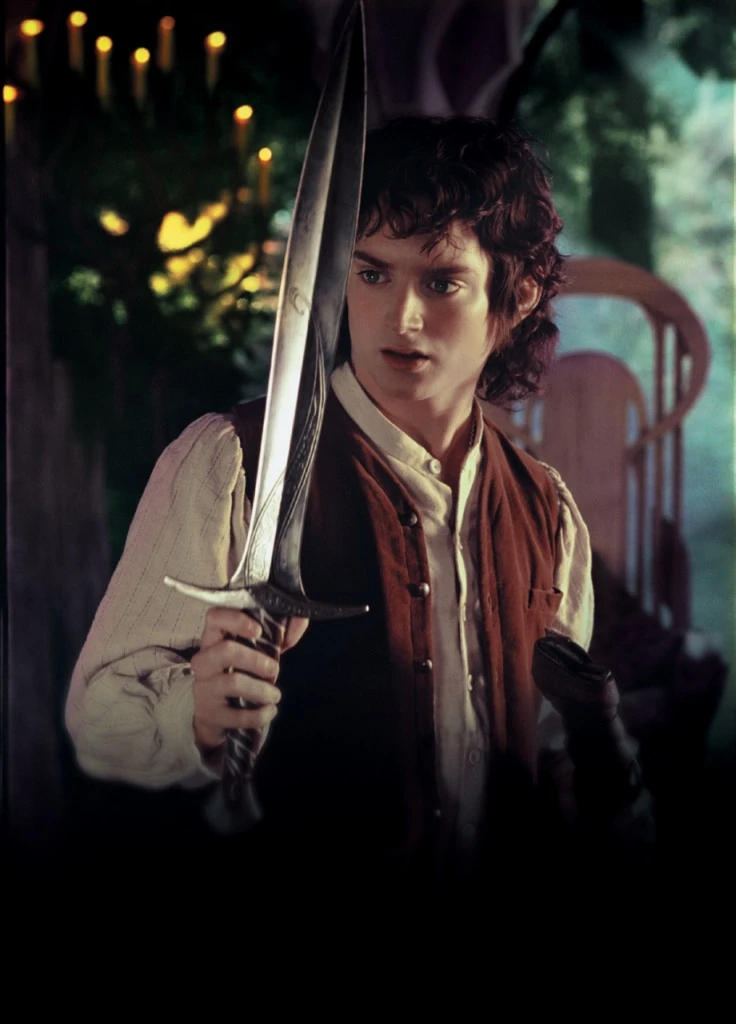
Frodo (portrayed by
Elijah Wood)

There are some things that I liked about the book. Shea's personality was nothing like that of Frodo's, and I liked how Brooks managed to make a point of making Shea see how flawed he was, since Shea had never seen himself as flawed or that he harboured any stereotypes (which he did, of the Trolls). Brooks managed to make the main character different from Frodo, as a human/elf hybrid is as far from a hobbit/halfling as you can get.

I managed to find a picture online of a man who kind of looks like how I pictured Shea in my head, so that was a plus. Thankfully, I liked the story enough that I was able to finish it, because if I hadn't liked it enough I wouldn't have finished it and I would have had to go back to the library and ask the librarian for another recommendation. My favourite aspect of the story would have to be, though, is the fact that it takes place thousands of years after a nuclear holocaust which brought the world as we know it (basically "the ancient Evil" in the synopsis) to an end. There are remnants of that world littered about the place—like in the Wolfsktaag Mountains, in a valley, there's the ruins of a city with an ancient guardian made of flesh and metal, obviously something mutated by the radiation from the nukes. And the Gnomes didn't dare to step in there, which obviously meant that in their culture there was a legend about the place which probably warned them not to go there because it might have been irradiated. The world's background in The Sword of Shannara was what fascinated me the most in this book.

The plot twists when they came were welcome and unexpected, placed in just the right places. I don't know when I will ever read The Sword of the Shannara again, but when I have money to burn I will buy a copy so I can have the chance to place it in chronological order like it is suggested on Goodreads. It'll be interesting to read Terry Brooks' books in chronological order because then maybe the story will make more sense.

§§§

Read in order to complete a category for Bookopoly Reading Challenge.
Qualifies as the book read for the year 1977 for a Century of Books Reading Challenge.

Tuesday, April 25, 2017

A Natural History of Dragons

A Natural History of Dragons. Marie Brennan. 2013. Tor Books. Pages: 334. [Source: bought]

You, dear reader, continue at your own risk. It is not for the faint of heart – no more so than the study of dragons itself. But such study offers rewards beyond compare: to stand in a dragon's presence, even for the briefest of moments – even at the risk of one's life – is a delight that, once experienced, can never be forgotten....
~~~

All the world, from Scirland to the farthest reaches of Eriga, knows Isabella, Lady Trent, to be the world's preeminent dragon naturalist. She is the remarkable woman who brought the study of dragons out of the misty shadows of myth and misunderstanding into the clear light of modern science. But before she became the illustrious figure we know today, there was a bookish young woman whose passion for learning, natural history, and, yes, dragons defied the stifling conventions of her day.

...a gust of shockingly cold air pulled at my sleeves, and ice stung my face. Wondering if we were in danger of hail, I looked up.
 I have little recollection of the next several seconds. Just a moment of frozen staring, and then – with no transition – my voice shrieking "Get down!" as I wrapped my arms around my husband and dragged him forward, off the wagon bench.


~~~

Rating: ✭✭✭✭✭

(Warning! This post contains spoilers! I couldn't help myself!)

This is another book that has been sitting on my shelf for over a year, waiting for my to get through whatever books I have been reading so I could pick it up with a clear conscience (there's nothing like guilt from having too many books on the go at once to ruin the experiance of a perfectly good book).

I really wished I hadn't waited so long to get to this! It was so good, and definitely not the kind of book I should have picked up when I was supposed to be writing a research paper on C.S. Lewis!

This novel is totally unique, and so satisfactory that when I finished it this afternoon I felt a longing to continue reading about Lady Trent's life and exploits. (I can't just go order the next instalment of the series since it chocks up to being over $30 Canadian for the hardcovers, unfortunately, and I'm collecting them in hardcovers because they're so pretty. So I'll have to wait, blah).

I have never before have read a novel that was purposefully written so that it read like a memoir. I had a sneaking suspicion that it would when I cracked it open, but I wondered how the story would fare since – well... memoir + fiction? It's volatile stuff.

But it worked so perfectly for this story, and I could hardly tear my eyes away from the pages in order to write my paper!

The story opens in Lady Trent's youth, when she was young, seven year old Miss Isabella Hendemore. She went out to play one day and found a small, dragon-shaped creature lying in the grass, dead. When she tried to take it home with her, it disintegrated in her hands – later the family cook would teach her how to properly preserve one in vinegar, and when young Isabella manages to jar an intact specimen, she names it 'Greenie', after its colour.

That was the moment her dragon fever, of a sorts, was born. It continued to drive her crazy until she was involved in an incident that forced her to conform to society – until she entered into her "season", the period of every young lady of high standing's life where they have to parade around until they met a man of high standing and they come to an agreement.

Isabella, faced with a lifetime of having her interests an intelligence stifled by the society-driven assumptions of the man she may one day call her husband, agrees to go with her brother to the king's menagerie, and it is there she meets her husband: Jacob Camherst.

It isn't long after they're married that they set off on an adventure into the mountains of Vystrana, where the rest of the story unfolds.

I fell in love with all of the characters, and the form of storytelling. I love Isabella and Jacob, and Mr. Wilker reminds me of Rodney McKay from Stargate: Atlantis (same sarcastic, high-strung kind of guy).

There are a few swear words, but nothing harsher than what I've heard my mother say when she's in a right royal mood (which is rare, and since we're Christian, it's nothing above a Parental Guidance).

At the beginning, when Isabella married Jacob, I wondered why his last name was 'Camherst' and not 'Trent', since Isabella is known as 'Lady Trent' in the future and not 'Lady Camherst'. I distinctly remember thinking, He's going to die, isn't he?

Now, if you've ignored my initial warning about spoilers, I'm afraid I've spoiled some of the story for you already. But I'm going to warn you again – stop reading if you haven't read A Natural History of Dragons yet! I'm going to be discussing the end past this point and I don't want to ruin it for you!

Anyway, now that that's out of the way...

Well, my hunch ended up turning out to be right. Jacob died, and that quite upset me. I liked Jacob! I didn't want Jacob to die! And because of where he died, he couldn't even be buried at home where Isabella could visit him regularly. It kind of reminds me of how Grandpa's grave is in BC, all alone.

The dragons in the story were quite impressive, and I was mildly reminded of How to Train Your Dragon while I read. In a good way.

I love the distinction of the world in this story. Usually, in fantasy, the society and world in the story is distinctly medieval. In this novel, the world is set at a technology level comparable to what we were at from 1812 to 1900 – there were steamboats, but according to Lady Trent there were yet to be railways and steam engines, yet there were steamboats – though I think they were comparable to the ones with the large paddle-wheels on their sides instead of ones of the Titanic's caliber.

I love the illustrations in this book – there're so lifelike! One was creepy in a few aspects, the one depicting Zhagrit Mat, sent shivers up and down my spine. I half expected Zhagrit Mat to come leaping out somewhere in the story since, well, it's a fantasy! Anything could happen in a fantasy! That amped up the tension because so much was happening. It was delightful!

The story world of A Natural History of Dragons is one I would love to daydream about, and I honestly can't wait to get my hands on the sequel, The Tropic of Serpents. Maybe I can get my hands on it before I come back to college...

Ah! I love it when I come across a good book!

Saturday, February 18, 2017

Book Review: Dreamlander

Dreamlander. K.M. Weiland. 2012. PenForASword Publishers. Pages: 544. [Source: Bought]

What if it were possible to live two very different lives in two separate worlds? What if the dreams we awaken from are the fading memories of that second life? What if one day we woke up in the wrong world?


~~~

Rating: 
 ★ ★ ★ ★


This book... man, what a treasure! I am so glad I stumbled upon it. I can only thank K.M. Weiland for her leading me to her story, since I've been reading and trying to follow along with her writing advice.

Immediately, I found myself connecting with Chris Redston, the main character of the story. Usually, it takes me two or more chapters to settle down and decide if I like the main character enough to want to follow them through the rest of the story. My connection with Chris was stronger than with any character than I can remember in recent memory. And that thrilled me.

Due to college, the first 25 to 40% were kind of slow, and it took me longer than I liked to get reading. But then I couldn't put it down, and I ended up eating up the rest of the novel like it was the best of Swiss chocolate. Everything was so well-rounded, and you knew what all the main players were doing when you needed to know what they were going. Usually, writers tend to follow the main character and sometimes the deuteragonist, and other important characters would pop up and strike with their plot-twisting purpose before promptly vanishing again. But not in Dreamlander.

You followed Chris, Allara, and Orias Tarn almost evenly throughout this 60-chapter story.

~~~

So his life was careening toward a dead end.
So he was using work as an excuse to run away. 
At least it was safe. At least it was sane. Mostly.

~~~

I loved the genre of this story so much. I went in thinking it was a high fantasy and wondering exactly what the glowing device was in Chris' hand on the cover. But then it quickly occurred to me, when Chris became more and more immersed in the "dream world" - the world Chris would go to when he fell asleep - that it was high fantasy mixed with steampunk. And I love steampunk just as much as fantasy and science fiction.

K.M. Weiland's writing voice was so smooth that it didn't distract me from the story. The dream world and the countries of Lael and Koraud felt so real that I could see myself navigating the streets as if I was following Chris as he went about. I didn't want to leave when Chris left.

I felt fear and connected with the events of the story when I was introduced to the protesters and eventual terrorists/rebels who joined with the bad guys. Nateros (I think that was how it was spelled) echoed with so many things that are happening today, in reality, and it took my breath away, because she was able to make it believable.

This is definitely a book I would like to get in physical format when and if she makes a sequel for it (because I've heard she's been considering it...). And I definitely want to read it again someday. Great job, K.M.!

There was so much I felt when reading this story, but there's no possible way I would be able to put it all down!

Friday, July 22, 2016

The Magician's Nephew

The Magician's Nephew. The Chronicle's of Narnia #1. C.S. Lewis. 1955. HarperCollins Publishers. Pages: 221. [Source: Childhood Gift]


He never finished what he was going to say for at that moment something happened. The high-backed chair in front of the fire moved suddenly and there rose out of it - like a pantomime demon coming up out of a trapdoor - the alarming form of Uncle Andrew. They were not in the empty house at all; they were in Digory's house and in the forbidden study! Both children said "O-o-oh" and realized their terrible mistake. They felt they ought to have known all along that they hadn't gone nearly far enough. 

 • •

Make your choice, adventurous Stranger;
Strike the bell and bide the danger,
Or wonder, till it drives you mad,
What would have followed if you had.

 • •

The Magician's Nephew continues to be my favourite Narnia novel. It's not because it's the first novel, no, it's because of what Digory and Polly have to go through and what they see on their way to and while they're in Narnia.

I can still remember the day when my father gave me my boxed set of The Chronicles of Narnia - I was in second grade, I think, and I was getting ready to go to an assembly with my father at the school I was going to (Comox Elementary, which has sadly been closed down). He handed me the boxed set and let me open it, and told me he would read the books to me whenever he could. And he did, though the last novel I remember that he read to me was The Horse and His Boy. I read the rest by myself because my father, I guess, soon became too busy to just sit down and read to me.

The story starts with Polly playing out in the garden when a boy peeks his face up over the wall dividing his garden from her own. The boy, who she was soon to learn was named Digory, was crying because of how ill his mother was getting. After that meeting, they become good friends and go regular little adventures, you know, the kind kids like to do.

But one day, they go up into the attic and decide to try and go explore the empty row house attached to their houses. But they make a grave mistake and accidentally enter into Digory's attic, where they discover that his uncle has converted the attic into a study...

This has to be my most favourite Narnia novel. There's so many things that happen in it that make me think. Think, think, THINK, think, THINK! And I love it when a book makes me THINK.

One of the parts of the books that makes me think the most is the part when Digory and Polly appear in Charn and take in what's left of that world. The fact that Charn's sun is red and "tired"-looking immediately makes me think that Charn's sun was a red giant - which is a star that has reached the end of it's life. It was hanging low over the horizon, so it made me think that it had probably swelled from its original size and took up most of the sky by the time Digory and Polly got there. Charn was an old world, and yet the sun had always been large and red, according to Jadis.

The fact that Charn was no more by the time Digory and Polly's adventure in Narnia was over unsettles me a bit, and I don't know why. 

I deeply love C.S. Lewis' style of writing in this book. It makes it sound like a lovely fairy-tale and it sucks me in every time I open this story. I look forward to the day I can read it to my kids, like my father did to me.

One thing I wish I could do, though, was find one of the sets of green and gold rings that Uncle Andrew created. I would love to explore the Wood between the Worlds, just to see what other worlds there could have been. My curiosity always gets to me like that. What other worlds were there other than ours and Charn and Narnia?

Note: I never realized, until now, that Digory and Polly lived in the Victorian era, when Sherlock Holmes still solved mysteries and the thought of motor-cars were still a bit of a ways away...

Friday, February 26, 2016

The Silmarillion

The Silmarillion. J.R.R. Tolkien. Published posthumously by Tolkien's son, Christopher, in 1977. George Allen & Unwin Publishers Ltd. Pages: 365. [Source: Borrowed from the Library].

"There was Eru, who in Arda is called Ilúvatar; and he made first the Ainur, the Holy Ones, that were the offspring of his thought, and they were with him before aught else was made. And he spoke to them, propounding to them themes of music; and they sang before him, and he was glad."

"Then those of the Ainur who desired it arose and entered into the World at the beginning of Time; and it was their task to achieve it, and by their labours to fulfill the vision which they had seen. Long they laboured in the regions of Eä, which are vast beyond the thought of Elves and Men, until in the time appointed was made Arda, the Kingdom of Earth. Then they put on the raiment of Earth and descended into it, and dwelt therein."

~~~

When I borrowed The Silmarillion from the library, I knew that I would probably struggle through it since Tolkien wrote it like a history textbook more than a story.

And rightfully so - The Silmarillion is basically the history textbook for Middle-Earth, so it doesn't flow like normal fiction at all. There are three more tomes out there that delve even more into the world that's Middle-Earth - but this is a book review for The Silmarillion, so I'm not going to talk about them.

Now, there's a lot about this book that I liked. The only parts I found that I didn't like was the fact that there was bad guys and evil and that it seemed like, whenever something beautiful was made it was destroyed by the evil. But there's always evil where there's good, unfortunately.

Eru Ilúvatar (air-u ill-oo-va-tar) is basically Middle-Earth's/Arda's Aslan/Emperor across the sea (if you compared Arda to Narnia). He's the one who was behind the creation of Middle Earth, though he didn't create it directly. Instead, he bid a group of angelic beings, the Ainur, to sing it into existence. I compare the Ainur to angels because Melkor, an Ainur, eventually turned against Eru, thus becoming Arda's Satan. I compared the events of the story while I was reading it to those of the Bible because Tolkien took a lot of inspiration from and made sure that there was a Christian message woven into his stories.

Reading The Silmarillion was very informative, and I found that it helped me to piece together a lot of events that occurred in The Lord of the Rings. In my opinion, it's a book I would like to own so I could go back and read over the stories when I want to - and I would get a newer edition where the letters were bigger so I didn't end up reading the same sentence more than once. And I'm definitely not reading it all in one go, ever again, lol.

I would give this book a rating of 4/5, since I felt like I was in Middle-Earth, watching from the sidelines, but it's not something I would want to read again for a very long time.

Ranger's Apprentice: The Battle for Skandia, a review

The Battle for Skandia . John Flanagan. 2006. Puffin Books. Pages: 294. Price: USD $8.99/$11.99 CAN. Setting: Skandia. ISBN 0142413402. [S...